|
|
|
|
|
|
|
Norfolk Regiment
Military History  Army English Regiments Army English Regiments  Norfolk Norfolk |
|
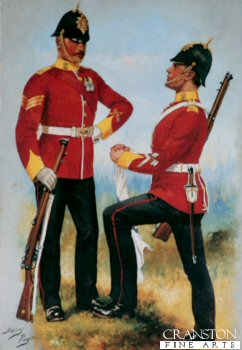
Photographs of the Norfolk Regiment during the reign of Queen Victoria THE ROYAL NORFOLK REGIMENT The Regiment was formed as Cornwell's Regiment in 1785, becoming the 9th of foot in 1751, and becoming the Royal Norfolk Regiment in 1935. Amalgamating with the Suffolk regiment in 1959 as the 1st East Anglian regiment. REGIMENTAL BATTLE HONOURS.
VICTORIA CROSS AWARDS. Six members from the regiment received Victoria Cross's. One during World war One, and Five during World War Two. |
|
|
The Norfolk Regiment This regiment was raised in Gloucestershire in 1685, with Henry Cornwell as colonel. In the Irish wars it served Londonderry, the Boyne, Molhill, Ballymore, Athlone, Aughrim, Galway, and Limerick; and next in Holland, at Kaiserswerth, Venloo, Ruremonde, Stevenswart, and Liege, Huy, and Limburg. Thence it sailed for the Peninsula, where, at the defence of Castel de Vide, the gates of the town were treacherously opened to the enemy, and the regiment was made prisoner of war. It also fought at Valencia de Alcantara, Albuquerque, Badajoz, Alcantara, Ciudad Rodrigo, Villena, and Almanza, where again it was compelled to surrender, losing in the action more than three-fourths its strength in rank and file, and twenty-four officers. Only the Colonel, Stewart, with a few officers and men escaped, and these, taking refuge in Alcira, were besieged in their turn and also compelled to surrender. It saw no further active service for more than sixty years, when it formed part of the expedition against Belle Isle and Havannah. In 1776 it embarked for Canada, and after fighting at Fort Ticonderaga, Skenesborough, Castletown, Fort Anne, and Wood Creek, it surrendered with Burgoyne at Saratoga. Colonel Hill preserved the colours by taking them from their staves and concealing them in his baggage; he was afterwards allowed to retain them by the King. Finally they were trooped at Sandhurst, and lodged in the chapel of the Royal Military College. The title ?9th Foot? appears officially in 1751, and the county title ?East Norfolk? was added in 1782, to be changed to the present designation in 1881. Between 1788 and 1800 the regiment assisted at the capture of Tobago, Martinique, St. Lucia, Guadaloupe, Bergen, and Egmont-op-Zee, and in the expedition to Ferrol. From 1799 to 1803 there were three battalions, and a second battalion was re-formed in 1804, and lasted until 1815. As a two battalion regiment the 9th fought in the Peninsula between 1808 and 1814 in ninety recorded actions, for which ?Roleia,? ?Vimiera,? ?corunna,? ?Salamanca,? ?St. Sebastain,? ?Nive,? and ?Peninsula? are borne on the colours; and for eleven others ?honorary distinctions were granted.? In 1842 it formed part of the ?Army of Vengeance.? Under General Pollock; fighting at the Khyber Pass, Mammoo Khel, Jugdulluck, Tezeen Pass, Huft Kotal, and Istaliff, and earning the distinction ?Cabool, 1842,? for the last of honours. With the army of Sutlej, under Sir Hugh Gough, the 9th was engaged at Moodkee, Ferozeshah, and Sobraon, bearing these names also on the colours. During the Crimean War it shared in the siege operations before Sevastopol from November 1854, until the termination of hostilities. The present 2nd battalion was added in 1858, and, after serving in China and Japan, was transferred to India to take part in the Jowaki campaign of 1877-78, and in the Afghan War of 1879-80, for which it bears the name of ?Kabul, 1879,? and ?Afghanistan? on its colours. The scarlet uniform now has white facings; but at first these seem to have been orange, and in 1751 were yellow. The regimental badge is a figure of Britannia, but with an olive- branch instead of a spear in the right hand (as was formerly used). This was said to have been given by Queen Anne for services in Spain; but it is not referred to in the warrants of 1751, or 1768. It is borne on the button, tunic collar, helmet-plate, forage- cap, and waist-plate. On the latter also is the Castle of Norwich, derived from the Norfolk Militia. The 3rd and 4th battalions are formed from the 1st and 2nd Norfolk Militia, raised in 1759. The Volunteer battalions are the 1st, 2nd, 3rd, and 4th Norfolk, with head- quarters at Norwich, Great Yarmouth, East Dereham, and Norwich. All wear scarlet with white facings. The ninth have long been known as the ?Holly Boys?-it is said from the ?Britannia? on the cross-belts, which the Spaniards thought was the ?Virgin Mary?; but this seems rather far- fetched. It is also said to have arisen from the men having used the leaves of a Bible for wadding on one occasion. The depot was at Norwich. JOHN MANNERS SMITH (Lieutenant, now Major, C.I.E.) Indian (Bengal) Staff Corps, Formerly 9th The Norfolk Regiment Decorated for conspicuous bravery at the attack and capture of a strong position occupied by the enemy near Nilt, in the Hunza Nagar country, on December 20th 1891. From their almost inaccessible position, the enemy had barred the advance of our men for seventeen days, but two parties of fifty rifles eventually dislodged them, the first being under the command of Lieutenant John Manners Smith. For nearly four hours he steadily moved his handful of men from point to point on the face of an almost precipitous cliff, whenever he was bale to avoid the showers of rocks hurled upon him from the enemy above; and during the entire time he was quite unable to deend himself for any attack the enemy might choose to make. Eventually the summit of the cliff was reached, which was within a few yards of the tribesmen?s sangars, into which he led his gallant little band and shot the first man with his revolver. The Gazette states that it was entirely due to the splendid leading of this officer, together with the coolness and dash he displayed, that a success was obtained. Born at Lahore, August 30th 1864, son of the late Charles Manners Smith, F.R.C.S., Major Smith was educated at Trinity College, Stratford-on-Avon; King Edward VI School at Norwich, and the R.M.C., Sandhurst. Lieutenant in the Norfolk Regiment 1883-8, joining the Indian Staff corps, and serving with the 3rd Sikhs and 5th Goorkha Rifles 1885-7. On the mission of Sir Mortimer Durand to Sikkim in 1888 and to Cabul in October 1893, this officer formed one of the staff, being created C.I.E. for his services. He has held political appointments in the East from 1889-98, taking part in the Isazai and Tirah Expeditions. |
|

4th Battalion March past |

4th Battalion: Sergeant Drummer Mace and the Band |

The Regimental Colours |
|
| ||||||||||||||||||||||||||||||||||||||||||||||||||||||||
|
Contact Details |
|
Sign Up To Our Newsletter!
This website is owned by Cranston Fine Arts. Torwood House, Torwoodhill Road, Rhu, Helensburgh, Scotland, G848LE Contact: Tel: (+44) (0) 1436 820269. Email: Email Us |
 |