|
|
|
|
|
|
|
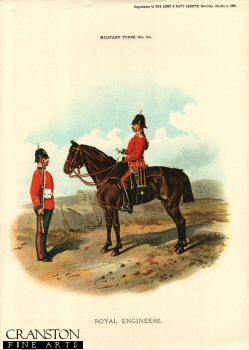
Royal Engineers
Military History  Army Army  Royal Engineers Royal Engineers |
|
History and photographs of the Royal Engineers. The Corps of Royal Engineers were raised in 1716, Officers, Royal artillery and Corps of Engineers, in 1787 the Corps was established separately, and in 1856 Royal sappers and Miners were incorporated into the Corps of Royal Engineers VICTORIA CROSS AWARDS. In total forty six members of the corps received the
Victoria Cross. Eight during the Crimean war, Eight during the Indian
Mutiny two during the Bhutan Campaign of 1865, one in the Ashanti War one
in the Zulu and Basuto war, Two in the second Afghan war, One in the
Hunza Campaign of 1891, Two in the Mohmand Campaign of 1898, Two in
the Boer war Seventeen in the first World war and two during the
Second world war. MICHAEL SLEAVON (Corporal) Royal Engineers Decorated for conspicuous bravery on April 3rd 1858, at the attack on the Fort of Jhansi, when in the words of the Gazette, he, ?Maintained his position at the head of a Sap, and continued the work under a heavy fire with a cool and steady determination worthy of the highest praise.? Sleavon died some years ago. His Victoria Cross was sold in London, on January 22nd 1903 for ?53. MARK SEVER BELL (Lieutenant, now Colonel, C.B., Retired) Royal Engineers This officer was decorated with the Victoria Cross for his conduct at Ordahsu on February 4th 1874, which was stated-in the words of the Gazette-to be ?zealous,? ?resolute,? and ?Self-devoted.) Sir John McLeod, commanding the 42nd, was an eyewitness and testified to his courage and fearless bearing. He urged on and encouraged an unarmed working party if Fantee labourers-who were exposed not only to the fire of the enemy, but also to that of our own native troops in the rear-to do what no European party was ever required to do in warfare, namely, to work under fire in the face of the enemy, without a covering party. His splendid example very materially contributed to the success of the day. Colonel Bell, P.S.C., C.B., son of Mr. Hutchinson Bell, Leconfield, Yorkshire, was born at Sydney, New South Wales 15th 1843. educated at King?s College London. Entered R.E. 1862; Captain 1874, Major 1882, Brevet Lieut. -Colonel 1884, Brevet-Colonel 1887, Colonel on Staff and commanding R.E., Western District 1894-8, commanded R.E. and Bengal Sappers and Miners, and Assistant Field Engineer Bhutan Campaign 1865-6 (medal and claso); commanded R.E., and Assistant Field Engineer, Hazara Campaign 1868. His conduct in this letter campaign was brought to notice, and his forced march of 600 miles specially mentioned. During the Ashanti War of 1873-4 he was Adjutant R.E. Brigade, and special Service officer, being mentioned in despatches for other acts than that foe which he was awarded the Cross; intelligence Officer Burman Expedition 1886-7; A.Q.M.G. for Intelligence 1880-85; A.D.C. to Her late Majesty 1887-1900; C.B., 1893. Well known as a great traveller in the East and an author of military and geographical articles. Fellow of King?s College London. McGregor Gold Medallist, U.S. Institute, India. REGINALD CLARE HART (Lieutenant,
Now Major-General, K.C.B.) Royal Engineers
The Lieut. ?General commanding the 2nd Division
Peshawur Field force brought the name of this officer to notice for a
particularly fine act od courage and humanity near Dakkah.
Lieutenant Hart was on convoy duty at the time, January 31st
1879, and a large body of the enemy, who poured a very heavy fire upon
it from the hills, attacked the force.
A Sowar of the 13th Bengal Lancers fell seriously
wounded, 1,2000 yards distant from Lieutenant Hart, who, on seeing the
precarious position of the man, ran to him, drove off his assailants,
and with the assistance of some men who came up shortly afterwards,
carried him under cover. During
the entire time he was exposed to the rifle fire of the enemy from the
banks of the river, and also from a party of them in the riverbed
itself. Major-General Hart
has the R.H.S. medal for saving life at Bologne on July 27th
1869, and another medal from the Mayor of that City; a Medal of Honour
first class, from the President of the French Republic; a Silver Clasp,
R.H.S., for saving the life of a gunner in the Ganges Canal, Roorkee,
December 15th 1884.
Sir R. C. Hart, son of the late Lieut.
?General H.G. Hart was born at Scarif, Co. Clare, Ireland, on June 11th
1848. Educated at
Marlborough Cheltenham, and R.M. Academy.
Lieutenant R.E. 1869; Brevet-Colonel 1886; Assistant Garrison
Instructor 1874-8; Garrison Instructor 1885-8; Director of Military
Education in India 1888-96. Besides
the Afghan War, has served through Egyptian War 1882, in which he was
twice mentioned in despatches, receiving Brevet of Lieut. ?Colonel the
medal and clasp, 4th class Osmanie and Khedive?s Star;
through the Tirah Campaign 1897-8, in which he commanded the 1st
Brigade, for his services in which he was mentioned in despatches,
received medal and two clasps, and created K.C.B.
From 1896-9 commanded the Belgaum District of Madras, and since
1899 the Quetta District of India.
Now commands at Chatham. EDWARD PEMBERTON LEACH Captain, now Major General, C.V.O., C.B.) Royal Engineers The action in which General Leach gained the Victoria Cross was fought among the hills of Afghanistan, far away in the Khyber Pass, against the Shinwarris, at Maidanah, on March 17th 1879. Captain Leach?s command was covering the retirement of a survey escort bearing lieutenant Barclay (45th Rattray?s Sikhs), who was mortally wounded. The escort was sorely pressed on all sides. Leach placed himself at the head of the brave Sokhs, and dashed against overwhelming numbers of the tribesman. In the encounter he slew three of them, himself receiving a severe wound from an Afghan knife on the left arm. But for his determination and gallantry the whole party would have been annihilated. Major-General Leach, son of Sir George Leach, K.C.B., R.E., was born on April 2nd 1847, at Londonderry. Educated at Highgate School and R.M.A. Woolwich, entering the Royal Engineers in 1866. In the Looshai Expedition 1871, his first active service, he was mentioned in despatches and received the thanks of the Government of India. Later he served in the Afghan War from the first to the last, and besides the Victoria Cross, was mentioned in despatches, obtaining Brevets of Major and Lieut. ?Colonel. Took part in the operations at Suakin 1885 (despatches and C.B.), commanded the troops at Korosko 1885-6, and the British Brigade at Assouan in 1886-7. In command of the 9th Division 3rd Army Corps. Since 1900 has commanded the Belfast District. JOHN ROUSE MERRIOTT CHARD
(Lieutenant, afterwards Colonel) Royal
Engineers
The Defence of Rorke?s Drift will go down
to posterity as one of the finest examples of British heroism, and the
names of Chard and Bromhead will hold a prominent position in the annals
of the British Army. The
late Queen Victoria caused their names to be inscribed on the colour
pole of the 24th Regiment, together with those of Lieutenants
Melvill and Coghill, who fell so heroically on the banks of the Buffalo
River on the same day, while endeavouring to save the colours of the
regiment from the enemy after the Massacre of Isandlwana.
Colonel Chard, son of Mr. W.W. Chard, of
Pathe, Somerset, and Mount Tamar, Devon was born in 1847.
Educated at Plymouth New Grammar School, Cheltenham and Woolwich
he entered the Royal engineer in 1868.
He was stationed at Bermuda for some time, ultimately going to
South Africa on the outbreak of the Zulu War.
After the Defence of the Drift, for which, in addition to the
Victoria Cross, he was promoted Captain and Brevet-Major, he became ill
of fever, and went to Ladysmith to recruit his health, but recovered
sufficiently to take part in the battle of Ulundi. Towards the end of 1879 he was ordered home, and on his
arrival at Plymouth was met by a telegram from the late Queen and
received by her at Balmoral. He
retired from the service in August 1897, and died at Hatch Beauchamp
Rectory, near Taunton, Somerset, on November 1st 1897. FENTON JOHN AYLMER (Captain, now Colonel) Royal Engineers On December 2nd 1891, an Expedition sent into the Hunza Nagar country arrived at the Nilt Fort. Our force consisted of about a thousand men, mostly Kashmir Imperial Service Troops, and sixteen British officers. The fort, which had to be attacked, standing at the extremity of a ledge, which overhung the Nilt nullah, was protected on three sides by a precipice, and the only approach to the gate had been strongly defended by abattis of branches. It was impossible to bring the mountain guns to bear on this part, owing to the impracticability of ragging them up the cliffs which overlooked it, and for a long time a hot rifle-fire was kept up by our men, which was equally severely replied to by the enemy from their loopholed stronghold. At length it was resolved to taje the fort by storm, and, to enable an entry to be made, the great gate had to be blown in. This dangerous duty was entrusted to Captain Aylmer, in command of the Engineers, and a hundred Goorkhas, under Lieutenants Boisragon (V.C.), and Badcock, supported him. While the Gootkhas hacked at thebranches of the abattis to make an entrance, the three officers, with a small handful of men, sprang through the opening and forced the gate of the outer wall. Captain Aylmer then, in a most cool and courageous manner, advanced under heavy fire and placed the charge of gun-coton against the main gate, lighted the fuse, during which he was shot in the leg, and retired to await the explosion. For some reason the charge failed to ignite, upon which he returned, arranged the charge afresh, and re-lit the fuse. He was again severely injured in the hand by a rock hurled from above by one of the enemy. The explosion, which now took place, sufficied to blow in the gate, and the officers, followed by their men, dashed through and commenced a terrific hand-to-hand combat with the defenders, who after a most desperate reisitance, were driven from the Fort. Captain Aylmer, though again severely wounded, fired nineteen shots with his revolver, killing several of the enemy, and remained fighting, until at last, owing to loss of blood, he had to be carried out of action. The following is another account of his marvellous pluck, and athletic prowess, given in The Relief of Chitral by Captains G. J. and F. E. Young husband- ?During the construction, a very prompt and plucky act on Major Aylmer?s part saved the life of a soldier. About a mile up stream, where the first floating bridge had been constructed, a flying bridge and rafts were still working backwards and forwards to supply the Guides with their wants on the other bank. One of these rafts, on which we were two men of the Devonshire Regiment Maxim Gun Detachment, got accidently overturned, and the boatmen and oars were washed away. The two soldiers managed to climb on to the raft and were carried down stream at a great pace. General Gatacre, seeing the accident, immediately galloped down to the site of the new beidge to give warning, in the hopes of saving the men. Meanwhile one of them had made an attempt to jump on shore and had been swept away and drowned, and the survivor on the raft came flying down the torrent. With the greatest presence of mind MajorAylmer immediately slipped down a slack wire that was across the river and just managed to grab the soldier as he shot past. The raft was immediately fater dashed to pieces on the rocks below. With considerable difficulty they were both hauled on shore and it was then found that the Major was badly bruised and cut by the wire. The Royal Humane Society?s medal has been given for many a less distinguished act of bravery, yet I do not think that, in the stir of passing events, it actually occurred to any of the spectators to send the recommendation home.? Fenton John Aylmer, 2nd son of the late Captain F. J. Aylmer, 97th Regiment, was born at Hastings April 5th 1862. Educated privately. Joined Royal Engineers 1880. Served in India since 1883; has been A.A.G., and acted as A.Q.M.G. and D.Q.M.G., Army Headquarters. Served in Burma Expedition, 1886-7 (despatches, medal and clasp); Hazara Expedition 1891 (despatches clasp); Hunza Expedition 1891-2 (despatches, clasp, V.C., Brevet-Major); Isazai Expedition 1892; Chitral Expedition 1895 (despatches, medal and clasp, Brevet-Lieut. ?Colonel). At present A.Q.M.G. Madras Command (Ootacamund). THOMAS COLCLOUGH WATSON
(Lieutenant, now Captain) Royal
Engineers
On September 16th 1897, Lieutenant Watson, while at
the attack on the village of Bilot in the Mamund Valley, collected a few
men of the Buffs and Bengal Sappers and led them into the burning
village, in order to dislodge some of the enemy who were inflicting loss
on our troops. With
conspicuous courage he made two gallant attempts, but was, on both
occasions, repulsed and severely wounded.
Captain Watson, born April 1st
1867, entered the Army in 1888, and was promoted to his present rank on
November 19th 1898. JAMES MORRIS COLQUHOUN COLVIN (Lieutenant, now Brevet-Major) Royal Engineers On September 16th 1897, at the village of Bilot, in the Mamund Valley, Indian Frontier, Lieutenant Colvin, after Lieutenant Watson (V.C.) had been incapacitated from his wounds, continued in the attempt to drive out the enemy from the burning village. His conduct was most brave, and his devotion to his men most noticeable, as, during the whole affair, a very heavy fire was kept up against them by the enemy. Born at Bijnor, India, on August 26th 1870, Major Colvin is the son of Mr. J. C. Colvin, late Bengal Civil Service. Educated at Charterhouse and royal Military Academy, he joined the Royal Engineers in 1889, becoming Lieutenant in 1892; Captain April 1st 1900; and Brevet-Major, August 1902, for his services in South Africa as an officer on special service. Took part in the Chitral Releif Force, 1895; Malakand Field Force 1897 (mentioned in despatches); Buner Field Force 1898; and Siuth Africa 1901-02. ROBERT JAMES THOMAS DIGBY JONES (Lieutenant) Royal Engineers Lieutuenant Robert James Thomas Digby Jones was killed in action during the great assault on Ladysmith, on January 6th 1900, after successfully defending Waggon hill West with a few men for twelve hours under desperate conditions, displaying conspicuous bravery and gallant conduct throughout. Sir George White, in his despatch stated he ?would have had great pleasure in recommending Lieutenant Digby Jones and Trooper Albrecht for the distinction of the Victoria Cross had they survived.? In the London Gazette of August 8th 1902,it was announced that the King was graciously pleased to direct that the Victoria Cross earned by Lieutenant Digby Jones, Trooper Albrecht, and four others should be sent to their representatives. Lieutenant Digby Jones accompanied the 23rd Field company R..E. to natal in June 1899, proceeding straight to Ladysmith, where he was employed in the Construction of a Hospital in the camp (afterwards abandoned when the siege commenced) and afterwards on the defences of the town). He was mentioned in Sir George White?s despatch (December 11th 1899) for having successfully destroyed the 4.7 Boer gun on Surprise Hill, during the sortie from Ladysmith on December 10th 1899, under the command of Colonel Metcalfe, with some 500 men of the rifle brigade. Newspapers correspondents afterwards mentioned that the first fure inserted was defedtive and that ?Lieutenant Digby Jone went at the risk of death or mutiliation and inserted another,? which successfully destroyed the gun, which had been causing much annoyance to the garrison. He was again mentioned in despatches in connexion with the ?Assault on Adysmith, January 6th 1900.? On the evening of the 5th January, Lieutenant Digby Jones had beens ent to Waggon Hill West command of a working party, consisting of thirty Sappers, some bluejackets, Gordon Highlanders and Imperial Light Horse, to make an emplacement for a 4.7 gun. At about 2.45 a.m. on the 6th they were surprised by the Boers, and, after ordering the men to stand to arms, Digby Jones, at once himself extinguished the lanterns which were giving a line for the enemt fire. There they made a most gallant stand till about 5.30 a.m., when reinforcements arrived. Later on, when all the officers of the Gordons and Imperial Light Horse had either been killed or wounded, he took command, and rallying the hard pressed men again and again, kept the crest of the hill. Space does not allow of mention of all that is recorded but a brief summary of an incident mentioned by Major Rice may be given. The sudden appearance of a party of Boers on that part of the hill had caused its worn-out defenders to retire in disorder, when Digby Jones got his first intimation of the presence of the enemy, under De Villiers, on the crest, in the shape of a shot over the parapet at a distance of only a few feet, which killed 2nd Corporal Hunts R.E. In a moment Digby Jones picked up a rifle, and, dashing round the end of the emplacement, shot De Villiers, Lance-Corporal Hockaday at the same time shouting De Jaegers. Digby Jone was then heard to say, ?What?s up? The infantry have gone.? A man replied, ?There is an order to retire, sir.? Digby Jones said, ?I have no order to retire,? and at once ordered bayonets to be fixed and calling his men to follow him, led them (with 2nd Lieutenant Denniss, R.E.) to the charge, reoccupying the firing line in front of the emplacement. Later on while leading his men forward, he was struck in the throat by a bullet and was instantly killed. A study of the position shows of what vital importance the tenure of Waggon Hill West was to the safety of Ladysmith; so much so that the South African Review, in a paragraph on Lieutenant Digby Jones, says, ?So far as can be humanly judged it was this officer who saved Ladysmiths and the British arms from the mortification of a defeat and its incalculable consequences.? And the army and navy gazette, from which portions of the preceding account are borrowed says, ?General Ian Hamilton, who had witnessed his intrepid and resourceful conduct through the day, had decided to recommend him for the Victoria Cross, which was fully approved by Sir George White, and subsequently brought forward in his despatch.? This fine young soldier was only twenty-theee years of age. His brother officer, 2nd Lieutenant G. B. Denniss, hearing Digby Jones was down, went out on the ridge, which was swept by the enemy?s fire, to search for him, and was, unfortunately, shot while performing this deed of mercy. Quoting from a correspondent the Army and Navy Gazette says, ?Lieutenant Digby Jones? name will stand out in history of the siege of Ladysmith as one who set a brilliant example to all about him, and brought no little credit on the corps of Royal Engineers. He did his duty nobly to the end!? Lieutenant Digby Jones was the second son of Charles Digby Jones, of Chester Street, Edinburgh. He was born September 27th 1876, educated first at Alnmouth, Northumberland, and afterwards at Sedbergh School, Yorkshire where he won the Sedgwick Mathematical prize in 1893, and was in the 1st XV. For football, and the 2nd XI. at cricket. He passed into Woolwich in 1894, thirty-fourth in order of merit, when bifurcating for Royal Engineers was fifth, and passed out sixth in the Royal Engineer Division, obtaining his commission on August 5th 1896. After completing his course of intruction at the S.M.E., Chatham, he was posted to the 23rd Field Company R.E. He was good all round athlete, being especially prominent in his golf and skating. At the former he won the Boys Scratch Medal at north Berwick two years in succession, and while at Chatham was sevretary of the R.E. Golf Club, forming one of the team in the annual inter-regimental matches with the Royal Artillery in the years 97, 98, and 99 doing the best round for the Sappers in the latter year. He was also secretary of the R.E. Rugby Football Club while at Chatham, and was one of its foremost players. He is buried in Ladysmith Cemetery, and a cairn was erected by the 23rd Field Company R.E. on the spot where he fell, as a memorial to him and to those Sappers who fell near him on Waggon Hill. In addition to a brass tablet put up in St. Mary?s Cathedral, Edinburgh ny his parents and brothers, his old Scottish schoolfellows erected one in the Parish Church at Alnmouth. In the History of the Royal Military Academy (written by Captain Guggisberg, R.E.) it states: -?In the Spring term, 1901 the octagon of the west library was turned into a kind of Sapper Valhalla. The walls were covered with handsome oak panels, on which were inscribed, in gold letters, the names of dead and gone engineers who had distinguished themselves in the service of their country, ranging from Waldivus, Ingeniator (1086) to a young subaltern, Digby jones, V.C. There are only 120 names on these panels. By a strange coincidence his younger brother, Lieutenant Owen G. Digby Jones, was commissioned to the Royal Engineers on the very day his brother was killed (January 6th 1900). He had many relatives who served in the Army with distinction, amongst whom may be mentioned- I) His Grande Uncle-Major-General John Christie, C.B., A.D.C. to Queen Victoria, who rasied the 1st Bengal Cavalry, better known as ?Christie?s Horse,? in 1838, which he commanded to the end of the Afghan War. Seven medals. II) His Cousin-Major-General John Moore Graham, who served through the Indian Mutiny and received through the Secretary of State for India, the ?most gracious approbation of Her Majesty? for services performed during that period. III) His Cousin-Lieut. ?Colonel Robert Hope Moncreiff Aitken, V.C. who earned the Victoria Cross on six different occasions during the siege of Lucknow, and was ten times mentioned in despatches. FRANK HOWARD KIRBY (Corporal, now Sergeant Major) Royal Engineers On June 2nd 1900; Kirby was one of a party who had beens sent out to cut the Delagoa Bay Railway. While retiring, they were hard pressed by a large number of Boers, both mounted and on foot, and several small rearguard actions were fought. During one of these, one of the men had his horse shot under him, and he commenced to try and ctch up his troop, running after them on foot, under a full fire of the enemy. Kirby turned and rode back to him, and succeeded in getting him on to his horse, all the time under a heavy fire, at quite close range, after which he rode back with him, over the rising ground, to where the rearguard had taken up a fresh position. Frank Howard Kirby, born at Thane, Oxfordshire, November 12th 1871, son of Mr W. H. Kirby of that town, was educated at Alleyn?s School, dulwich, and entered the Royal Engineers at St. George?s Barracks, London, on August 8th 1892. He embarked for South Africa, upon his first active service, on October 29th 1899, gaining, almost at once, theMedal for distinguished Conduct-blowing up the railway near Bloemfontein, March 1900. During the campaign he gained, under the immediate command of Colonel A. Hunter-Weston, D.S.O., the King?s and Queen?s Medal and six clasps. The Gazette states that the occasion described above was third upon which Kirby displayed great gallantry in the face of the enemy. He was frequently named in despatches, was promoted Sergeant-Major in the field by Lord Roberts (July 1900), being presented with the Victoria Cross by H.R.H. the Duke of Cornwall and york at Cape town, on August 19th 1901. EDWARD TALBOT THACKERAY (Lieutenant, now colonel, K.C.B.) Royal (Bengal) Engineers On September 16th 1857 fire broke out in a shed in the Delhi magazine in which large quantities of ammunition were lying about. Lieutenant Thackeray, although under a heavy fire from the Sepoys, and not withstanding that the flames were all round the combustible stores, most daringly rushed in, and, by his exertions, contrived to extinguish them. Colonel Sir Edward Thackeray, son of the Rev. Francis Thackeray, first cousin of Thackery the novelist, was born on October 19th 1836, educated at Marlborough and Addiscombe, and entered the R.E. in 1854. Served in Afghan War 1879. Promoted Captain 1865; Major 1872, Lieut. ?Colonel 1880, Colonel 1884, and retired in 1888. Was from 1880 Commandant of the Bengal Sappers and Miners. HENRY NORTH DALRYMPLE PRENDERGAST (Lieutenant, now General G.C.B.) Royal (Madras) Engineers On November 21st 1857, at Mundisore, Lieutenant G. Dew, of the 14th Hussars, was in imminent danger of being shot by a Velaitee, who covered him from the rear with his musket. Lieutenant Prendergast rushed at him and cut him down, but not before being wounded himself by the discharge of the piece. His gallant action saved the life of Lieutenant Dew, but he was almost cut down in his turn, had not Major Orr killed the rebel. He also distinguished himself at the actions of Ratgurh and Betwa, being severely wounded. Major-General Sir Hugh Rose, in forwarding his recommendation of this officer, states- ?Lieutenant Prendergast was specially mentioned by Brigadier Stuart for the gallant act at Mundisore when he was severely wounded; secondly; he was specially mentioned by men when acting as my A.D.C. in the action before besieging Ratgurgh on the Beena River for gallant conduct. His horse was killed on that occasion. Thirdly, at the action of the ?Betwa,? he again voluntarily acted as my A.D.C. and distinguished himself by his bravery in the charge, which I made with Captain Need?s troop, against the left of the Peishwa?s army under Tantia Topee. He was severely wounded on that occasion.? Son of Thomas Prendergast, Madras Civil Service, Sir Henry Prendergast was born in India, October 15th 1834. Educated at Cheam School, Brighton College and Addiscombe, he entered the Army in 1854, serving in the Persian War, 1856-7; with the Field force 1857, and the Central India Field Force 1858, in the two latter services being severely wounded and mentioned in despatches; through the Abyssinian War 1868, and the Indian Expedition to the Mediterranean 1878; Upper Burma 1885-6, being thanked by Her Majesty Queen Victoria and the government of India. Has held many distinguished positions in Travancore and Cochin 1887; Mysore and Coorg 1887 and 1891; Baroda 1889; Baluchistan 1889. JOHN JAMES McLEOD INNES (Lieutenant, now Lieut. ?General, Retired) Royal (Bengal) Engineers Sultanpore was held in force by the rebels, and was attacked on February 23rd 1858. A line of skirmishes covered the advance. In the far distance the guns of the enemy could be seen. Our skirmishers were closely pressing them, and, abandoning a gun, they were retiring, only to take up a fresh position. Here they had loaded a heavy piece, the fire from which would have ploughed through the column, had not Lieutenant Innes dashed ahead a one and shot the gunner before he could fire, remaining undaunted, the mark for hundreds of matchlocks and riflemen sheltered in huts close by, and beating back the gunners until aid reached him. By his courageous act the guns were captured, the rebels routed, and many lives were saved. CHARLES AUGUSTUS GOODFELLOW (Lieutenant, now General) Royal (Bombay) Engineers Thos was the last Victoria Cross granted in connexion with the Indian Mutiny, and the place of action appears to have been where the last stand was made, at Beyet, in Katty war, Western India. On October 6th 1859, Lieutenant Goodfellow highly distinguished himself, as he had already done throughout the Mutiny. A soldier of the 28th Regiment having been shot under the walls of the fort, Lieutenant Goodfellow rushed to his rescue, being exposed the whole time to heavy rifle and matchlock fire. Although he succeeded in conveying him, after great difficulty, into shelter, he discovered that, in spite of his efforts, the man was dead. JAMES DUNDAS (Lieutenant, afterwards Captain) Royal (Late Bengal) Engineers This officer was associated with Major-General Trevor (V.C.), in a particularly daring act of bravery at Dewan-Giri in Bhootan, on April 30th 1865. Further details of the heroic conduct of these officers are given in the account of Major-General Trevor. Captain Dundas was killed on December 23rd 1879, during the Afghan War, under circumstances, which showed that he had lost none of that bravery which had so characterized him fourteen years previously. Our Engineers were blowing up several forts, and at one of them Captain Dundas and Lieutenant Nugent constructed three mines. All being ready, the officers withdrew all their men to safety and lighted the three fuses, but two being defective exploded almost instantly, burying Captain Dundas and his gallant companion in the ruins of the fort. Captain Dundas was born on September 12th 1843. He was the son of George Dundas, a Judge of the Court of Session in Scotland, was educated at Edinburgh and Addiscombe, and entered the Bengal Engineers in 1860. Colonel Vibart, in his work Addiscombe, relates that Captain Dundas saved the life of a native in 1878 at Simla, under particularly courageous circumstances. A house in the Bazaar having caught fire, the roof had fallen in, burying the native, who, unable to get out, was in great danger of being alive. Captain Dundas attempted to save the man by himself, but failed so calling for a volunteer to help him, the two together succeeded in accomplishing the difficult and dangerous task. WILLIAM SPOTTISWOODE TREVOR (Major, now Major General, retired) Royal (Bengal) Engineers Associated with Lieutenant Dundas (V.C.), in a most gallant and courageous exploit during an attack on a blockhouse at Dewangiri, in Bhootan on April 30th 1865. Major-General Tombs (V.C.), the officer in command reported that about 200 of the enemy had barricaded themselves in a blockhouse and driven off Being the key to the enemy?s position, and considering it most necessary to act promptly before the main body of the Bhooteas should return and rally, and as our men ahd been fighting for three hours in a boiling sun, Major-General Tombs gave orders to Lieutenant Dundas and Major Trevor to lead the attack. They had to climb up a wall which was fourteen feet high, and then to enter a house occupied by some 200 desperate men, head foremost through an opening not more than two feet wide, between the top of the wall and the roof of the blockhouse. Major-General tombs states that on speaking to the Sikh soldiers around him and telling them in Hindustani to swarm up the wall, none of them responded to the call, until these two officers had shown them the way, when they followed with the greatest alacrity. How Trevor and Dundas escaped death was marvel. Perhaps the very restricted space at the point of entrance had something to do with their success, the defenders being unable to use their swords effectively and getting jammed in their eagerness to close with them; while the officers used their revolvers with fatal effect until the cleared the gallery and enabled the storming party to effect a lodgement. About sixty of the garrison, mostly wounded surrendered; the rest were killed fighting to the last. Major-General Trevor, born in India, on October 9th 1831, was the son of Captain R.S. Trevor, who was murdered by Akbar Khan, at Cabul in 1841, at the same time as Sir Wm. McNaghten was done to death. Educated at Addiscombe, he entered the Army in 1849. Served through the Butrmah Campaign, 1852-3, being severely wounded at the taking of the White House Picket Stockade at Rangoon April 12th 1852, and for his conduct was mentioned in despatches. Present at the action at Donabew March 19th 1853, and again wounded and mentioned for his gallant conduct. Served against the Dacca Mutineers in 1857, and through the Bhootan War of 1865, when he gained the Victoria Cross. Has been employed a great deal in the Public Works Department of India, having been Provincial Chief engineer, Director-General of railways, and Secretary to the Indian government. |
|
General Hart V.C,. C.B. (right) and Colonel Hart (left) of the Royal Engineers. (1898) Brothers from the Royal Engineers, photograph taken during the Afridi War. General Hart served in the Afghan War 1878-80, the Egyptian Campaign against Arabi, being present at both Kassassin and Tel-El-Kebir. His Victoria Cross was won in the Afghan War, for running some 1200 yards under fire to the rescue of a wounded Bengal Lancer, driving off his assailants and bringing the wounded man under cover. |
|
Eleven Sergeants and Thirty-Seven Medals. This photograph represents eleven non-commissioned officers of the Royal Engineer mess at Aldershot, each one of whom is in possession of the good conduct medal, and from one to three war medals in addition. There are altogether thirty-seven medals distributed among the eleven, and we have never heard of an instance in which so many good conduct medals were to be found in one non-commissioned mess. This decoration, it will be remembered, is only granted after eighteen years' exemplary service. That it should be found in such profusion in a sapper's mess is not surprising, as the corps of Royal Engineers is perhaps all round the best conducted in the British Army. Consisting too, of men who are for the most part clever artificers, it pays the War Office very well to offer special inducements to long service in the way of pay and allowances, although in many cases these last are by no means so large as would be drawn for such skilled labour in civil life. A glance at the war medals worn by these eleven non-commissioned officers is a sufficient reminder of the added fact that the Royal Engineer is a first class fighter as well as worker, and his gallantry in carrying out his duties under fire is well known. |
|
How Lieutenant Cyril Gordon Martin, D.S.O., Held The Enemy Back For Two And A Half Hours And Won The V.C. |
|
How Sapper Harry Epstein, of the Royal Engineers, Won The D.C.M. At Hill 60 Saturday May 8th 1915, was an eventful day for our army in Flanders, for early that morning the Germans began an attack in overwhelming force upon the 28th Division, which resulted in the whole of the British centre, after an heroic resistance and terrible losses, being driven in, and our line forced back west of the vitally important Frezenberg Ridge, which covered all the roads from Ypres by which our supplies and reinforcements travelled. It was likewise an eventful day for sapper Harry Epstein of the royal Engineers; indeed, it may be doubted whether, during the present war, any British soldier has undergone a more nerve shattering experience, or escaped death, in various forms, in more miraculous a fashion, than did Sapper Epstein in the course of some twenty minutes of that May morning. It all happened in a trench at the foot of Hill 60, at the southwest extremity of the Ypres salient. Hill 60 is only a Hill by courtesy, being no more than an earth heap from the cutting of the Ypres-Lille railway. But it was a very important place, since it afforded an artillery position from which a considerable part of the German front could be commanded. On the evening of April 17th, it was captured by the British and gallantly held against a series of the most desperate counter attacks, which were accompanied by so terrific a bombardment that for four and a half days the defenders lived through a veritable hell. But what shell and rifle and machine gun fire had failed to accomplish, poison gas did, and on May 5th the enemy recaptured the greater part of the hill. And thus it was that a couple of days later Germans and British found themselves occupying parts of the same trench, both having erected barricades at their respective ends, to guard against any unwelcome attentions on the part of their neighbours. In the course of that afternoon, while Epstein and some of his comrades of the 5th Company Royal Engineers were resting previous to their night work, orders suddenly came for a non-commissioned officer and six sappers to proceed to the Brigade headquarters and make preparations for the blowing up of some German barricades, and Epstein was selected as one of the party. On arriving there they prepared two charges of gun cotton, one weighing forty pounds and the other a trifle less, and placed the slabs of the explosive in wooden boxes which Epstein constructed, with holes bored through them to let in the primers and detonators. One of these charges was to be laid against the German barricade, the other against the British; the former was to be blown up first, and the moment this had been done, the British barricade would also be blown up, and our men, headed by a grenade party, would burst in upon the astonished Huns, while another party of the British simultaneously attacked from the other side of the trench, and so cut the enemy off. Their preparations competed, they started off for the trench, carrying the charges, electrical leads, detonators and all the rest of the paraphernalia connected with a demolition party, and reached it in safety, passing on their way through a lane of dead, who lay everywhere along it and the railway cutting. The corporal in charge of the Engineers and Epstein then proceeded to lay the first charge against our own barrier, a task of no small danger, since the Germans were throwing bombs all the time. It was now about half past two in the morning, and the time fixed for the attack was approaching. The officer in command called for two volunteers to carry and lay the second against the enemy?s barricade, and, if successful in this undertaking-and it was a very big ?if? indeed-to set the fuse. Epstein was the first to volunteer, another sapper named Warrel immediately following his example; and it was then arranged that, if they failed, two more of the Engineers should make the attempt, and in the event of a second failure, the remaining two; but that, if they were successful, they should get back as quickly as possible past our own barricade, which would then be immediately blown up. In order that the reader may appreciate the perilous nature of the duty required of these two brave men, we may here observe that they had no means of knowing what dangers they might not have to encounter between the two barricades, except that the enemy?s bombs were continually falling there; nor did they known definitely how far it was to the German barrier. They calculated, however, that it was about ten yards, and had prepared the charge accordingly with two detonators, in each of which was a safely fuse which would take roughly thirty seconds to bur through. Within that time they would of course have to get back behind their own barrier, or they might be blown to bits. Epstein having handed his watch and chain, diary, and other belongings to one of his friends, with instructions to whom they were to be sent in case he never returned to claim them, he and his comrade started for the unknown, the last words of the officer in command being ?Goodbye and good luck to you!? Epstein climbed over the British barricade and lowered himself gently down; the other sapper followed, and side-by-side they began to crawl along, carrying the charge between them. Both knew that it was touch and go with them, but both were perfectly cool and collected. Every foot of the way had to be covered as noiselessly as possible, for the Germans were certain to be on the alert, and they well knew that their lives depended on their preventing any intimation of their approach reaching the enemy?s ears. Gradually they drew nearer the barrier, and were just congratulating themselves on having reached it in safety, when, to their astonishment, they found that it was not a barrier at all but merely a huge traverse! The two men looked at each other, but neither spoke, for each read the unshakable determination in the other?s eyes. Then they began to crawl around the traverse, Epstein leading the way, for these was room for only one to pass at a time. Their situation was now more perilous than ever, for they knew not who might be lurking, and they had nothing with which to defend themselves. Slowly and fearfully they rounded it, and perceived, some ten yards ahead, a second traverse, but no sign of a barrier. Undismayed, the brave fellows kept on and had just reached the second traverse, when, with a tremendous explosion, two German bombs dropped immediately behind them, smothering them with earth, but happily doing them no harm. By this time they had crawled twice the distance they had counted upon, and still there was no barrier; but they had passed their word ?to do or die? and neither of them thought for a moment of turning back. And now, as Epstein peeped cautiously round the second traverse, he caught sight of the barrier ten yards further on. But he saw something else too-something, which made his heart, brave though he was, well nigh stand still. For in the barrier were two loop holes, one some two and a half feet above the ground, the other about as high again, to allow of a man firing through them either kneeling or standing. And from these loopholes the Germans had a view straight up to the traverse, the trench itself being perfectly straight and only just wide enough for Epstein to crawl along the bottom. However, for the two Engineers to remain where they were would be fatal, as the enemy bombs were falling still, and if one of them hit the charge they would be blown to the skies. And so, with a glance at each other, they crawled on and had got about halfway to the barrier, when a great uproar told them that the attack had begun. This they calculated would be certain to divert the attention of the Germans momentarily at least-from the loop-holes and resolved to make the most of their chance, they crawled forward as fast as they could, laid the charge against the barrier, and were just on the point of setting the fuse, when there came a defining roar and they found themselves once more smothered with earth. The British had blown up their barricade! What had happened was this: The officer in command of our men mistaking, as they all had, the first traverse, ten yards away, for the German barricade, and seeing the two bombs fall in the trench, naturally gave Epstein and his companion up for lost, and when the attack began he concluded that there was nothing to be done but to blow up his own barrier and let the grenade party through. Had the German barricade really stood where our men supposed it to be, there would have been no hope for the two adventurous sappers, for the explosion of forty pounds of gun cotton would kill every living thing within a radius of ten yards; but someone?s prayers must have been answered that night, for, as events turned out, they were not ten but thirty yards away, and only got covered with earth. Recovering from his astonishment, Epstein was once more on the point of setting the fuse, when round the corner of the second traverse came the officer at the head of the grenade party his eyes alight with the joy of battle and shouting at the top of his voice for more grenades. Of course, the Germans at once hurried to the loopholes in their barrier, and just as Epstein had managed to crawl back a couple of feet, he saw, to his horror, the muzzle of a rifle poked through the upper one. What he suffered in the next few moments may be imagined. He did not dare to rise, for if he had, he would have placed himself on the same level as the rifle, but out the corner of his eye, he saw the barrel being gradually depressed until it was pointed straight at his head. A kind of stupor appeared to come over him, and he lay there with closed eyes almost waiting for the bullet, it seemed impossible that the German could miss. And then Bang! And he was nearly blinded with earth; the bullet had passed an inch in front of his head and buried itself in the ground. At once Epstein seemed to be galvanized into action, for without giving the German time to take aim again he sprang to his feet, and in two bounds had reached the traverse, just as several bullets flattened themselves against the sandbags. Scarcely had he reached it, however, that he felt on the point of collapsing, and it was only with difficulty that he succeeded in making his way back to his comrades, amid the din of a furious conflict, artillery, machine guns, rifles, bombs, grenades, the shouting of the officer and the cries of the wounded-all blending together in one huge volume of sound. Sapper, now Lance Corporal, Epstein, who thus came safely through one of the most terrible ordeals which can ever have confronted a British soldier, and was subsequently awarded a richly deserved Distinguished Conduct Medal, is twenty-three years of age and a Lancashire man, his home being at 56, Cheetham Street, Cheetham, Manchester. Extracted from 'Deeds That thrill The Empire' How Acting Corporal John Henry Drew Williams, Of The Royal Engineers,Won The D.C.M. Near Wytschaete About seven o?clock in the evening, William?s section officer called for four volunteers to go out and cut the enemy?s barbed wire. Williams and three sappers at once volunteered, and were told to report themselves to the colonel of the Lincolns at the Advanced Headquarters. Here Williams received his instructions, and twelve men and a sergeant were detailed to assist him. He gave each of them a pair of wire cutters, and they made their way to our first line trenches, where they left their equipment behind the parapet, so as not to impede their movements. Williams then divided his party into two sappers, the sergeant and six of the Lincolns being sent to the left, while he himself, with the remaining sapper and the other six Lincolns, went to the right, that being the longest way, namely, about 120 yards as against sixty. They did not make a very auspicious start, as they were ?spotted? getting over the parapet, and a machine gun and several snipers opened fire upon them. However, none of them was hit, though William?s had his mouth and eyes filled with dirt thrown up by the rain of bullets, and they crawled on, making for the left hand corner of the wood. They passed a machine gun, which was in a hedge about sixty yards out, and also a sniper in a trench, which ran along the inside of a hedge, reached the enemy?s barbed wire, which was of the knife rest pattern, and cut the entanglements apart, placing them round the front of some old shell holes. Then leaving the only two men who had kept up with him to look for anything they could find in the corner against the wood, Williams went off alone to the right, making here and there gaps in the wire, and found a sap head about four yards along running out from the wood, and a sniper in it potting away at our lines. He crawled past him without attracting his attention, and about twenty yards further on came upon another sap. While investigating it, the base of a three-inch shell was suddenly thrown at him, which he picked up and put in his pocket, and on looking in the direction from which it had apparently come, he received a clod of earth in the face. He pushed himself backwards with his hands for about a dozen yards, still watching the sap and wondering why the Germans did not shoot; but after lying still for a while, he concluded that they must have taken him for an animal of some kind and started off again towards the right. This time he had better luck and found a trench running out at right angles from the wood. Crawling along it, he came into the enemy?s main front trench, which was in a terrible state, being half full of water. On his right en were baling out the water and using very bad language, and he remarked that many of the swear words they employed were English. Crawling out of the trench, he made his way into the wood, where he cut several telephone wires which he ran into, and found that, though the enemy had dug outs and communication trenches in the wood, there were no entanglements. Fearing that he might lose his way if he went any further, he returned to the spot where he had left his two men, and they went back to our lines and made their report to Captain Tachell, of the Lincolns, who complimented Williams very warmly. They party which had been sent out to the left had returned some time before, but their report was not very clear, so the officer asked Williams if he would take his own men out and investigate for himself. On their way they came across a dead pig, which had got itself entangled in our wire about twenty yards out, and, farther on, the bodies of several dead Frenchmen, which had lain there since the fighting in the early part of September. Reaching the hedge, which was about sixty yards from our lines, Williams found that the enemy had made a trench on the inside and had a covered machine gun emplacement in the right hand corner (it was this machine gun which did so much damage when the attack began), but no other obstacle in our way. He again made his report, and then went out and cut gaps in our own wire, so as to enable our men to deploy from several different places. Meantime, orders had been given to the Lincolns to get out of their trenches and lie down in front of the wire. But the noise they made in doing so attracted the attention of the enemy, and this started a premature attack, in which Williams found himself mixed up, with only a pair of wire clippers in his hand. The attack on the right was successfully pressed home, but the left fared badly, being held up by the machine gun in the hedge, which caused a great number of casualties. A sergeant at William?s side fell, hit in the ribs, and the engineer carried him to a shell hole just in front of our barbed wire, to which place of refuge he presently returned with a private, who had been wounded in the ankle, and left him there to keep the sergeant company, promising to send a stretcher party for them. Then having made his way to the right and informed the officer commanding there that the left was unable to advance any further, he went back to our lines, got a stretcher party and led them to the spot where he had left the two wounded men. They were conveyed to a cottage about 250 yards behind our lines, which was being used as a temporary hospital. There were several staff officers there, who all shook hands with Williams and complimented him on the courage and ability he had shown that night, and his name and number were taken and sent to General Headquarters. Williams, who went out with the Expeditionary Force in August and had been in the thick of the fighting ever since, was awarded the Distinguished Conduct Medal, promoted sergeant, and placed in charge of several bridges on the Yser Canal, which were frequently shelled by the enemy and in need of repair. The three sappers who accompanied him on that eventful night were awarded the Russian Cross of St. George (Third Class). Williams, who is thirty-four years of age, is a Kentish man, his home being at Tonbridge. Extracted from 'Deeds That thrill The Empire' How Captain William Henry Johnstone, Of The Royal Engineers, Won The V.C. At Missy Almost all the bridges which lay in the path of the advance of the 2nd Corps were found to have been destroyed, except that at Conde, which the enemy held in their possession until the end of the battle. The 5th Division eventually crossed the river at Missy. From the river, however, the ground stretches back flat and exposed for three quarters of a mile, and the 13th Brigade was unable to advance, as the enemy opened a heavy fire from the opposite bank. The 14th brigade, however, was directed to the east of Venizel, and was rafted across at a less exposed point. The 15th Brigade followed, and, later, both the 14th and 15th Brigades assisted the 4th Division on their left to repel a heavy counter attack delivered against the 3rd Corps. On the morning of the 13th the enemy was found to be in possession of the Vregny plateau. The Engineers then undertook the repair of the road bridge at Venizel, and the work was completed during the morning. The bridge, however, had been damaged to such an extent that it was left to the men to drag the gun across. In the meantime a pontoon bridge was begun to close to the road bridge, and this was completed at 5.30 p.m. The 12th Infantry Brigade had crossed at Venizel, and by one o?clock in the afternoon was assembled at Bucy Le Long. At 2 p.m. they began an attack in the direction of Chivres and Vregny, in the hope of gaining the high ground east of Chivres, and thus continuing the advance further northwards. Good progress was made until 5.30 p.m., but the enemy?s artillery and machine gun fire then became so heavy that further progress could not be made. While the 10th Infantry Brigade crossed the river and moved to Bucy Le Long, the 19th Brigade moved to Billy-sur-Aisne. Before dark all the artillery of the Division had been got across the river, except for the heavy battery and one brigade of Field Artillery. During the night the 5th Division took over the positions, to the east of the stream running though Chivres, which had been gained by the 12th Infantry Brigade. With the fall of evening the enemy had retired at every point, and entrenched on the high ground about two miles to the north of the river. But detachments of infantry were strongly entrenched in commanding places all down the slopes of the various spurs with powerful artillery to support them. All through the night of the 13th and on the 14th and following days the Field Companies were incessantly at work. Eight pontoon bridges and one-foot bridge were thrown over the river under very heavy artillery fire, and this was kept up continuously on to most of the crossings when completed. The three road bridges at Venizel, missy and Vailly, and a railway bridge east of Vailly, were repaired for foot traffic. The work done by the Royal Engineers was highly satisfactory, in repairs and reconstruction and in other ways. All through the 14th, until 7 p.m., Captain William Henry Johnstone worked with his own hands two rafts. He returned with the wounded from one side, to take back later supplies of ammunition. By this work, which was carried out under heavy fire, an advanced Brigade was enabled to maintain its position across the river. For his most gallant work Captain Johnstone was awarded the V.C. Extracted from 'Deeds That thrill The Empire' WILBRAHAM OATES LENNOX (Lieutenant, afterwards Lieut. ?General, K.C.B.) Royal Engineers On November 20th 1854, during the siege of Sebastopol, it became necessary to establish a lodgement in some dangerous rifle pits, overhanging the Woronzoff Road. Lieutenant Lennox was conspicuous, among many others, by his ?cool and gallant conduct? in repelling the numerous and persistent assaults of the enemy. This brilliant operation drew forth the compliment of a special order from Marechal Canrobert, of the French Army, at whose request the Rifle Brigade was selected to make the capture. Sir Wilbraham Lennox, son of the late Colonel Lord J. G. Lennox, was born in 1830, and served through the Indian Mutiny; with the German Army in the Franco-Prussian War, 1870; and with the Turkish Army during the Russo-Turkish War 1877. Brigadier-General in Egypt 1884-7, and in command of the Forces at Ceylon 1887-8, Director-General of Military Education 1893-4. WILLIAM JAMES LENDRIM (Corporal, afterwards Quartermaster-Sergeant) Royal Engineers He was practically prominent in setting a fine example of courage to a party of one hundred and fifty French Chasseurs, whom he was superintending, on February 14th 1855, during the building of No. 9 Battery, Left Attack and replacing all the capsized gabions under heavy fire. (Awarded French War Medal.) On April 20th he was one of the four volunteers to destroy the farthest Russian rifle pit. He died in October 1892 at Camberley, where he had long held the post of Quartermaster-Sergeant to the Staff College. HENRY McDONALD (Colour-Sergeant, afterwards Captain) Royal Engineers Decorated for conspicuous bravery on April 19th 1855, when engaged in effecting a lodgement in the enemy?s rifle pits, in front of the left advance of the right attack on Sebastopol. Later on in the day, the Engineer officers being wounded and the command developing on him, he persisted on the Sap, in spite of the repeated attacks of the enemy. He died in Glasgow on February 15th 1893, aged 70 HOWARD CRAUFURD ELPHINSTONE (Lieutenant, afterwards Major General, K.C.B.) Royal Engineers Knight of the Legion of Honour During the night of June 18th 1855, after an unsuccessful attack on the Redan, this brave officer collected together a party of volunteers of all corps and proceeded to bring back from under the enemy?s guns on the ramparts the scaling-ladders left behind during the assault, thereby saving them from falling into the hands of the Russians. No sooner had he finished his task than he again set forth, leading the same gallant men, to search for the wounded who were lying close up to the Redan, and whose cries for water could be heard in the distance from time to time. In this he was most successful, carrying in no less than twenty men himself. It is said to relate that Sir Howard Elphinstone was, on March 8th 1890, washed overboard and drowned when on a voyage to Madeira on R.M.S. Tongariro. Son of Captain Alexander Elphinstone, R.N., he was born at Riga, Northern Russia, on December 12th 1829. Educated abroad and at Woolwich, passing into the Royal Engineers in December 1847; became Captain 1856; Colonel 1864; Major General 1887; A.D.C. to H.M. Queen Victoria 1877-87. Commanded the Devonport district from 1889 until his death. GERALD GRAHAM (Lieutenant, afterwards Lieut. ?General, G.C.B., G.C.M.G.) Royal Engineers Knight of the Legion of Honour Sir Gerald?s first recorded conspicuous act of bravery happened on June18th 1855. The Redan-in compliment to our brave allies, and in order to obliterate the memories of another June 18th, just forty years before-was to be attacked, with what result is well known. Lieutenant Graham-he was then only twenty-four- led a ladder party right up to the cannon?s mouth. Our columns were repulsed, and obliged tom retire, and it was then that Lieutenant Graham sallied forth, and with great dash rescued from death and misery many wounded officers and men. Sir Gerald Graham?s later campaigns have been those of China 1860; (Medjidie) Egypt 1882; Eastern Soudan 1884; and Suakin 1885. Retired 1890. Son of R.H. Graham, M.D., of Eden Brows, in Cumberland, he was born on June 27th 1831,and died in his seventy-ninth year at Bideford, Devon, on December 17th 1899. PETER LEITCH (Colour Sergeant) Royal Engineers JOHN PERIE (Sapper) Royal Engineers Decorated for bravery in leading the sailors with the ladders at the storming of the Redan on June 8th 1855, the Gazette stating that his services on that occasion were ?invaluable.? He afterwards rescued a soldier who had been shot and was lying in the open, although having he been wounded by a bullet in the side just previously. JOHN ROSS (Corporal, afterwards Sergeant) Royal Engineers On August 23rd, when in charge of the advance from the 5th Parallel Right Attack on the Redan, he placed and filled twenty-five gabions under a most severe fire from the Russians. On the night of September 8th he crept alone right up to the Redan and found the enemy had evacuated it, upon which he reported to his officer and out troops took possession of it. |
| Navigation | |
| Page 1 of 2 | Page 1 .. Next |
| ||||||||||||||||||||||||||||||||||||||||||||||||||||||||||||||||||||||||||||||||||||||||||||||||||||||||||||||||||||||||||||||||||||||||||||||||||||||||||||||||||||||||||||||||||||||||||||||||||||||||||||||||||||||||||||||||||||||||||||||||||||||||||||||||||||||||||||||||||||||||||||||||||||||||||||||||||||||||||||||||||||||||||||||||||||||||||||||||||||||||||||||||||||||||||||||||||||||||||||||||||||||||||||||||||||||||||||||||||||||||||||||||||||||||||||||||||||||||||||||||||||||||||||||||||||||||||||||||||||||||||||||||||||||||||||||||||||||||||||||||||||||||||||||||||||||||||||||||||||||||||||||||||||||||||||||||||||||||||||||||||||||||||||||||||||||||||||||||||||||||||||||||||||||||||||||||||||||||||||||||||||||||||||||||||||||||||||||||||||||||||||||||||||||||||||||||||||||||||||||||||||||||||||||||||||||||||||||||||||||||||||||||||||||||||||||||||||||||||||||||||||||||||||||||||||
| Navigation | |
| Page 1 of 2 | Page 1 .. Next |
|
Contact Details |
|
Sign Up To Our Newsletter!
This website is owned by Cranston Fine Arts. Torwood House, Torwoodhill Road, Rhu, Helensburgh, Scotland, G848LE Contact: Tel: (+44) (0) 1436 820269. Email: Email Us |
 |