|
|
|
|
|
|
|
9th Lancers
Military History  Army Lancer Regiments Army Lancer Regiments  9th Lancers 9th Lancers |
[UP] - 9th Lancers - 12th Lancers - 5th Lancers - 17th Lancers - 16th Lancers - 21st Lancers |
| Photographs and history of the 9th Lancers, during the
reign of Queen Victoria.
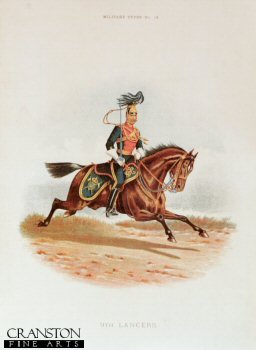
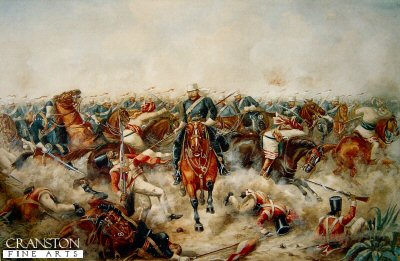
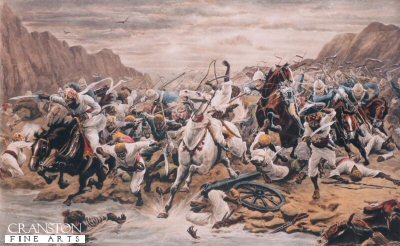
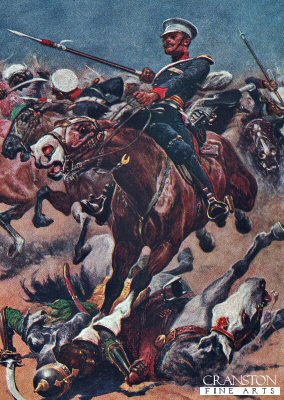
The second Lancer Regiment in order of precedence dates its origin from the year 1715. The death of Queen Anne had long been looked forward to by the Jacobites, as giving their faction an opportunity of placing their leader and head on the British throne as James III. Whether the Chevalier de St George ever really came to England and interviewed his sister the Queen, as Thackeray suggests in "Esmond", may be doubted, but there was evidently enough political disturbance in the air to render the Whig party, which favoured the new dynasty, uneasy. They had reason for this, as events proved; and, to promote a greater feeling of security, the small standing army was increased by seventeen additional regiments of dragoons and thirteen of foot. Of the former only six remain (now the 9th, 11th, 13th, 10th, 12th, 14th), the others, with all the new foot regiments, disappearing from the army list in 1718. Major-General Wynne was the first colonel, and raised his six troops chiefly in the southern counties. Their services were soon required. Supported by France, the standard of rebellion was raised by the Earl of Mar at Braemar, where the Duke of Argyll commanded what loyal troops there were in Scotland. Another insurgent centre was formed partly of Scots and partly of English, under Lord Kenmuir, and this force, the under the command of General Foster, invaded England, and reached Preston, which they had fortified and barricaded, the approaches being commanded by guns. Against this a force under General Wills advanced on the 12th of November. It consisted of the 3rd Horse (afterwards the 2nd Dragoon Guards), Wynne's, Honeywood's, Munden's, Dormer's and Stanhope's Regiments of Dragoons, and the 26th Foot. The Cameronians, supported by detachments of Dragoons, attacked from the Wigan Road, the Lancaster route being assaulted by the rest of the force. But so stout was the resistance that the village was fired before the defenders gave way and it was only on the second day of the fight that the rebels surrendered. With the return of the Pretender to France all further conflict ceased, and Wynne's Dragoons embarked for Ireland. In 1751 the clothing warrant describes the uniform as scarlet, with buff facings and breeches. The colours were of red silk for the King's guidon, and buff for the other troops. The former has the rose and thistle crowned with "Dieu et mon Droit" in the centre, and in the four compartments are panels bearing the the white horse of Hanover and the regimental number on a buff ground; the other guidons were centred with the regimental number on a crimson ground, within a wreath of roses and thistles, while the panels in this case were the white horse and a rose and thistle joined alternately. In 1783 they were converted into Light Dragoons, and the following year the uniform was changed to blue. Their first service since the rising of 1715 was again against rebels, in the Irish insurrection of 1798, and throughout the whole of that troubled year they were employed, frequently as isolated troops and in small bodies, against the universally numerically superior bands that seem, without any connected plan, to have been collected at different points. Much barbarity was shown by the have savage insurgents. In one case, for instance, Quartermaster Charles King, who had been taken prisoner in one of these numerous skirmishes, was shot in cold blood "for persisting in his loyalty to his sovereign". The regiment remained in Ireland until 1803, and did not again embark for foreign service until 1806, when it formed part of Sir Samuel Auchmuty's expedition to the River Plate, which they reached in seven weeks from England. They shared in the occupation of Monte Video, though not in its storm. But no effort was made to replace the dead and useless horses, so that after a while the regiment ceased to be effective as cavalry, and were used, for the first and last time in their history, as foot soldiers, in the brigade formed by the dismounted troops of the 6th Dragoon Guards and the 40th and 45th Regiments of the Line, under Colonel the Hon Thomas Mahon. To the dismounted cavalry was given the honour of attacking one of the central streets, with three troops of 9th Light Dragoons and four of the Carabiniers in the first line, and the other five troops of the former in reserve, and supported by two six-pounders. They behaved with the greatest bravery, but the attack was, on the whole, a failure, and General Whitelocke abandoned the place. They next shared in the ill-fated Walcheren expedition, losing 152 men there by fever, and in 1811 embarked for Portugal. At Aroyo de Molino they surprised General Girard, capturing 1,000 prisoners, the artillery, baggage, and stores of the force and taking General Brune prisoner. They took part in all the numerous skirmishes that occurred between 1811 and 1813, when they returned home with the permission to bear "Peninsula" on their appointments. In 1816 they were constituted Lancers, with, in 1830, the distinguished title of "Queen's Royal", in honour of Queen Adelaide, consort of William IV. Embarking for India, they took part in the Gwalior campaign at Punniar and Maharajpore, and soon after shared in the Sutlej campaign against the Sikhs. "Sobraon", "Punjaub", "Chillianwallah", and "Goojerat", are borne on their colours for their brilliant services in that campaign, where the Sikh horse was often "as numerous as the sands of the sea", where Sir Hope Grant on more than one occasion led them, and where as the enemy thought, "God had given them the victory." They were the recipients of the first bronze star, which was given after the war instead of the silver medal; and the regiment later on again gained the distinction of the similar star given to those who joined in Sir Frederick Roberts's march from Kabul to Kandahar. Again in the Mutiny they did good work, as at Delhi, where they shared in the skirmishes which preceded the fall of the city, one of which Colonel Abercromby Yule was slain, and, at Lucknow, where they earned the commendation of Lord Clyde. No cavalry regiment has a longer list of Victoria Cross men than the 9th Lancers, and it is well their names should be recorded. Thomas Hancock and John Purcell, Privates, were decorated for gallantly standing by theitrBrigadier, the J. H. Grant, C.B., when his horse was shot; Lieutenant A. S. Jones, afterwards Adjutant at the Staff College, almost single-handed captured one of the enemy's guns, but at Agra, four months later, was desperately wounded, receiving no less than twenty three wounds, and losing the sight of an eye by a sword cut; Lance-Corporal Goat, Private Newell, Troops Sergeants-Major Spence and Rushe, Privates Donohoe, Freeman and Roberts, distinguished themselves by attempts to save wounded officers or comrades; as did Lance-Corporal Kells and Sergeant Hartigan. The latter showed extreme gallantry on more than one occasion, and at Agra was dangerously wounded. Lastly, Lord William Beresford, when on the staff of the army operating in Zululand in 1879, won the highly prized decoration for saving Sergeant Fitzmaurice's life in the retreat of a reconnoitring party across the White Umvolosi River, in the presence of a large body of Zulus, by mounting him behind him on his horse and bringing him away, "under the close fire of the Zulus, who were in great force, and coming on quickly". Lastly, for their splendid services in Afghanistan, too long to retell here, they carry on their battle roll the names of Charasiah, Kabul 1879; Kandahar, 1880; and Afghanistan, 1878-80. The blue uniform has scarlet facings and black and white plume; and their honoured nickname is "The Delhi Spearmen", from the good use to which they put their lances in the Mutiny. The badge is the royal cypher within the Garter. Extract from "The British Army and Auxiliary Forces" Colonel C. Cooper King, R.M.A. , 1894 ALFRED STOWELL JONES (Lieutenant, now Lieut-Colonel) 9th (Queen?s Royal) Lancers On June 8th 1857, at Budle-K-Serai, Delhi, the squadron commanded by Lieutenant Jones charged the rebels and, although they offered a stout resistance, rode straight through them, killing the drivers, and capturing one of their guns. With the assistance of Colonel Yule, he turned it upon a village, strongly held by the mutineers, and drove them out. Sir Hope Grant stated in his despatch that nothing could have been better done or more gallantly executed. At Agra, on October 10th following, Lieutenant Jones received no fewer than twenty-two wounds, part of his head being cut away, and one eye destroyed, in spite of which he recovered. Born at Liverpool, January 24th 1832, Lieut. ?Colonel Jones is the son of the late Archdeacon Jones. Educated at Liverpool College and Staff College, Sandhurst, he entered the 9th Lancers in 1852. Throughout the siege of Delhi served as D.A.Q.M.G. to the cavalry, being there three times mentioned in despatches, and promoted Captain and Brevet-Major. Graduated at the Staff College 1861, served on the Staff at the Cape, 1861-7, retiring 1872. H. HARTIGAN (Sergeant) 9th Lancers
On October 10th following at
Agra, under circumstances of great bravery, he saved the life of
Sergeant Crews, who was attacked by four rebels (who had crept into the
camp), and though quite unarmed, Hartigan dashed for the nearest,
wrenched a tulwar from his hand, hitting him a blow in the mouth with
his fist, then turned and attacked the other three, one of whom he
killed, and wounded the two remaining.
He was, however, by that time so terribly wounded himself, that
he was unable to continue the combat, and was obliged to retire on
assistance arriving. THOMAS HANCOCK (Private) 9th Lancers
this gallant soldier was specially mentioned by Sir Hope Grant,
in command of the Field Force, for his courageous conduct on June 19th
1857. When that brave
leader?s horse was shot under him at Delhi, Hancock remained by him
and giving him his own mount, enabled him to be taken out of the hot
corner the cavalry were in at the time. With him were Private Purcell (V.C.) and a Sowar, Roopur
Khan. The former was
awarded the chief of decoration, but the Sowar?s name unfortunately
does not figure in the list of recipients. JOHN PURCELL (Private) 9th Lancers At Delhi, June 19th 1857, Purcell, with another brave lancer, Thomas Hancock (V.C.) and Sowar Roopur Khan, saved the life of Sir Hope Grant, by staying with him, offering him one of their horses, and getting him out of the melee when surrounded by rebel cavalry. Purcel?s horse was killed in the contest. P. DONOHOF (Private) 9th Lancers On September 28th 1857, at Boolundshuhur, during the charge in which Lieutenant Robert Blair (V.C.) so gallantly distinguished himself, Donohoe was greatly instrumental in assisting his officer in returning to camp after going to his support when so terribly wounded. ROBERT KELLS (Lance
Corporal) 9th Lancers
On September 28th 1857, at Boolundshuhur, Captain
Drysdale?s horse was shot, and he was thrown heavily, breaking his
collarbone. Kells, dashing
to his rescue, kept the enemy at bay until help arrived, and was the
means of saving him from certain death.
The portrait of this gallant lancer shows him in the uniform of
the Yeoman of the Guard, in which corps he is still serving.
In July 1901 was presented with the Royal Victorian Medal by H.M.
The King. J. R. ROBERTS (Private) 9th Lancers Decorated for conspicuous gallantry and devotion at Boolundshuhur, September 28th 1857, when, under a most galling fire, he brought a wounded comrade through the streets, being himself badly injured during his humae act. J. FREEMAN (Private) 9th Lancers At Agra, on October 10th 1857, Lieutenant Jones had been shot and severely wounded. Freeman, dashing to his officer?s assistance, killed the leader of the enemy?s cavalry and kept at bay the Sepoys surrounding him. His Cross in the United Service Institute, London. D. SPENCE (Troop Sergeant-Major) 9th Lancers Decorated for conspicuous bravery at Shumsabad, on January 17th 1858, when he rescued Private Kidd from the centre of a band of rebels. Kidd?s horse had fallen and he was badly wounded, and to reach him had to cut his way through several of the enemy. WILLIAM GOAT (Corporal) 9th (Queen?s Royal) Lancers. This brave young soldier took p[art in the siege and capture of Lucknow in 1858. On March 6th, while in action with the enemy?s cavalry, he coolly dismounted, took up Major Smyth, 2nd Dragoon Guards, who was thought to be only severely wounded, and attempted to remove him off the field. This, at first, he was unable to accomplish, being surrounded by the enemy?s horse. Nothing daunted, he made a second attempt, this time under a heavy fire, and succeeding in his endeavours-in defence of the rabble around him-removed the officer?s body out of reach of those waiting to mutilate it. William goat?s Cross with Mutiny medal was sold in London, in May 1902 for ?85. R. Newell (Private) 9th Lancers
Decorated for his bravery at Lucknow on March 19th
1858, when, under a heavy fire of musketry, he went to the assistance of
a comrade whose horse had fallen on bad ground, and brought him away to
safety. DAVID RUSHE (Troops Sergeant Major) 9th Lancers On March 19th 1858, this non-commissioned officer displayed conspicuous bravery near Lucknow in having, with one other soldier; attacked eight mutineers posted in a nullah, and killed three of them. LORD WILLIAM LESLIE DE LA POER BERESFORD (Captain, afterwards Colonel, K.C.I.E.) 9th (Queen?s royal) Lancers Previous to the battle of Ulundi, which broke the Zulu power and brought that sanguinary war to a close, reconnaissance was made across the White Umvolosi River on July 3rd 1879. The cavalry having pushed far out towards Ulundi, thousands of Zulus, hidden up to that moment in deep hollows, opened a brisk fire on our men. The ?retire? was sounded, and at that instant Sergeant Fitzmaurice, of the 24th was thrown from his horse, severely injured and partially stunned, and the Zulus being now only a few yards away, his fate seemed sealed. Lord William Beresford then rode back, cur his way to the man, took him up on his horse and brought him away safely. This task was rendered all the more dangerous and difficult owing to the fact that Fitzmaurice twice nearly pulled him off the saddle, but Sergeants O?Toole rendered valuable assistance by helping to keep the man on the horse at the same time checking the advance of the nearest Zulus with his carbine. O?Toole was deservedly awarded the Victoria Cross also, thanks to Lord William speaking on his behalf, for when commanded to Windsor to receive to decoration, he told Her late Majesty that he could not in honour receive the recognition of his services unless it were shared in by Sergeant O?Toole, who he generously affirmed, deserved infinitely greater credit than any which might attach to himself and the next Gazette announced O?Toole?s reward. Colonel Lord William Leslie de la Poer Beresford, third son of the Rev. John de la Poer, fourth Marquess of Waterford, was born on July 20th 1847. Educated at Eton, he entered the 9th Lancers in 1867 as Cornet, obtained his commission as Lieutenant in 1870, and his Captaincy in 1876. Was an A.D.C. to Lord Lytton, Viceroy of India, from the end of 1875 to October 1881. Served through the Jowaki Expedition 1877-8, this being his first active service. Besides the Zulu War, he served with the gallant Lancers in the Afghan War, being present at the capture of Ali Musjid, and from 1881 to 1894 was Military Secretary to the successive Viceroys of India, Lords Dufferin and Lansdowne. Became Major in 1884, and served with the Burmese Expedition, being mentioned in despatches and receiving Brevet of Lieut. ?Colonel. Became Colonel in January 1891. Died December 28th 1900. |
|
Drum-Horse of the 9th Lancers. (1896) The 9th (Queen's Royal) Lancers, whose drum horse we show opposite, was originally one of the Dragoon regiments raised early in George the First's reign. As Dragoons, the 9th served under Wellington in Spain. After 1816 they became Lancers, on the model of the celebrated Polish Lancers, who rendered Napoleon such devoted service. The 9th were at Sobraon and Chillianwallah, and in India during the Sepoy mutiny, the prowess of the "Delhi Spearmen" being a living recollection to many a grey bearded ex-rebel still alive. Since then they have greatly added to their fame in the East - under Lord Roberts, with whom they fought at Cabul, and marched to Candahar. This horse was presented to the regiment by Her Majesty the Queen, on their return to England from the Afghan War. Original magazine photo page published 1895 - 1902. Price ?25. Or reproduction of photograph ready mounted. Price ?25. Click here to order. ORDER CODE 1V59 |
|
Non-Commissioned Officers of the 9th Lancers. (1896) The 9th (Queen's Royal) Lancers, the non-commissioned officer of which well known regiment are here shown in undress uniform, have one of the best records of any cavalry corps in the Service. They were raised as Dragoons in the year 1715, and became Lancers after Waterloo. They fought under Wellington in Spain, and since then there is hardly a campaign in India in which the 9th Lancers have not borne a distinguished part. Their facings are scarlet, and plume black and white. |
| |||||||||||||||||||||||||||||||||||||||||||||||||||||||||||||||||||||||||||||||||||||||||||||||||||||||||||||||||||||||||||||||||||||||||||||||||||||||||||||||||||||||||||||||||||||||||||||||||||||||||||||||||||||||||||||||||||||||||||||||||||||||||||||||||||||||||||||||||||||||||||||||||||||||||||||||||||||||||||||||||||||||||||||||||||||||||||||||||||||||||||||||||||||||||||||||||||||||||||||||||||||||||||||||||||||||||||||||||||||
|
Contact Details |
|
Sign Up To Our Newsletter!
This website is owned by Cranston Fine Arts. Torwood House, Torwoodhill Road, Rhu, Helensburgh, Scotland, G848LE Contact: Tel: (+44) (0) 1436 820269. Email: Email Us |
 |